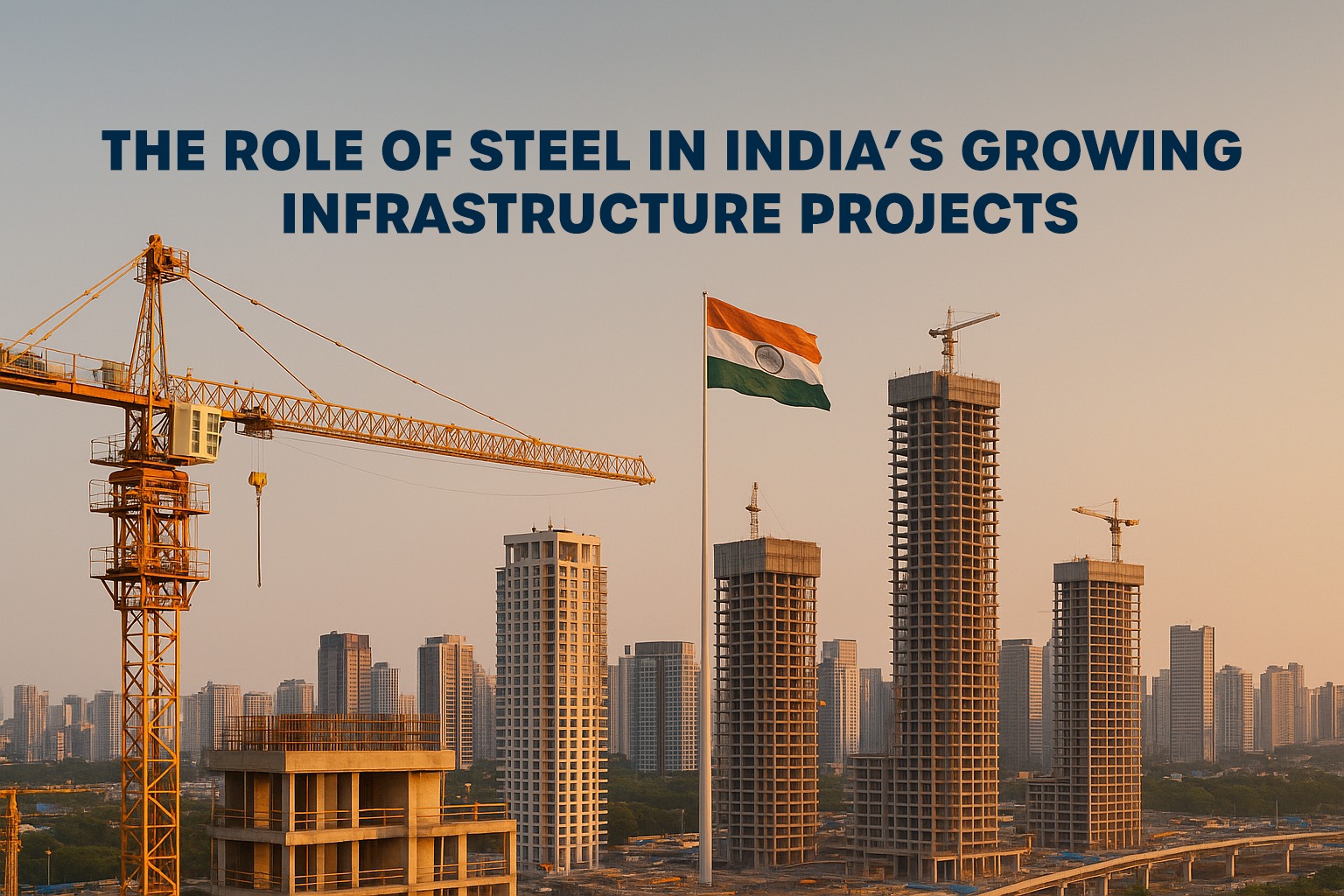
India’s skyline is changing fast.From the gleaming terminals of Delhi Airport to the rising metro networks across Tier-2 cities, the nation is witnessing an unprecedented infrastructure boom. Behind every bridge, flyover, and rail coach stands one indispensable material — steel.
Its strength, flexibility, and recyclability make it the backbone of modern infrastructure. With the government’s push through the National Infrastructure Pipeline (NIP) and PM Gati Shakti, the demand for reliable, high-grade steel has never been greater.
Steel: The Unseen Force of Progress
Steel’s contribution to infrastructure extends far beyond what the eye can see.
Its ability to withstand high stress, resist corrosion, and be endlessly recycled makes it a preferred choice for projects that define national development.
According to the Ministry of Steel, infrastructure and construction account for nearly 60% of India’s steel consumption — a figure projected to double by 2030 as new industrial corridors, highways, and smart cities take shape.
1. Bridges, Flyovers & Highway Structures
While concrete forms the road surface, steel is the true structural backbone of bridges, flyovers, and highway safety systems.
It’s used in girders, crash barriers, lighting poles, and pedestrian walkways — components that demand strength, flexibility, and corrosion resistance.
Grades like IS2062 E250 and E350 are widely used for bridge girders and structural members, while galvanized steel sheets are preferred for guard rails and signage supports.
Steel’s light weight and prefabrication potential make it ideal for rapid construction and minimal traffic disruption, especially in large public infrastructure projects.
2. Metro & Rail Infrastructure
Urban mobility projects depend on precision and performance.
From station roofing and platform structures to rolling stock and signaling systems, steel ensures safety and design uniformity.
Metro networks in Delhi, Hyderabad, Nagpur, and Pune extensively use galvanized and cold-rolled steels for both strength and corrosion protection.
These materials also simplify maintenance and improve lifecycle cost efficiency — a key factor for high-traffic systems.
3. Airports & Terminals
Airports are modern engineering marvels that combine functionality with architectural flair.
Steel’s versatility allows for expansive column-free spaces, curved roofs, and glass-and-metal facades that define today’s airport designs.
High-tensile hot rolled and galvanized steels make terminal roofing systems lighter, safer, and easier to maintain — enabling energy-efficient, sustainable structures.
4. Energy & Renewable Power
The transition to clean energy has unlocked new applications for steel.
From transmission towers and substation frameworks to solar module mounting structures, steel provides the mechanical integrity required to withstand diverse Indian climates.
Galvanized iron (GI) sheets and coils offer corrosion resistance in outdoor and coastal environments, ensuring long service life and safety for power infrastructure.
5. Smart Cities & Urban Development
As India’s cities evolve into smarter, greener ecosystems, steel’s adaptability enables modular, eco-friendly designs.
Pre-engineered buildings (PEBs) and lightweight steel frames accelerate construction while minimizing waste.
With its recyclability and energy efficiency, steel perfectly aligns with the goals of the Smart Cities Mission — to create sustainable urban habitats.
Sourcing & Reliability: The Hidden Strength Behind Every Project
Behind every landmark project lies an extensive supply chain — one that ensures the right grade of steel reaches the right site at the right time.
This is where sourcing partners like Sandeep Metal Works (SMW) make a measurable difference.
SMW procures certified steel from JSW, Tata Steel, AM/NS, and SAIL, maintaining strict adherence to BIS and ISO standards.
Our processing facilities handle decoiling, slitting, leveling, and cut-to-length operations — providing clients with project-ready materials that reduce fabrication time and on-site waste.
By combining mill-direct sourcing with nationwide warehousing and logistics, SMW ensures seamless steel availability for contractors, EPC firms, and developers involved in India’s growth story.
The Numbers That Tell the Story
- Per-capita steel consumption: 82 kg (2024) → Target 160 kg by 2030
- Investment under NIP: ₹100 lakh crore+ by 2030
- Infrastructure’s share in steel demand: ~60% and rising
- Top growth areas: Roads, railways, housing, renewable energy
(Source: Ministry of Steel, NIP Reports, India Infrastructure 2024 Outlook)
These figures show that India’s steel consumption isn’t just a metric of industrial health — it’s a measure of national progress.
Building India’s Future — Responsibly
As India advances toward its Vision 2047 goals, the focus is shifting to sustainable and high-strength steels that reduce environmental impact while improving structural performance.
By partnering with the nation’s leading producers, Sandeep Metal Works helps clients access next-generation materials that meet evolving design and green-building standards.
Whether it’s a metro rail expansion, a solar energy park, or an industrial corridor, SMW ensures that every delivery upholds one promise — strength, precision, and trust.
Conclusion
Steel doesn’t just build structures — it builds nations.
As India forges ahead with transformative infrastructure projects, its dependence on reliable steel supply chains becomes paramount.
By sourcing from JSW, Tata Steel, AM/NS, and SAIL, and providing precision processing and on-time delivery, Sandeep Metal Works ensures that every bridge, terminal, and tower stands as a symbol of India’s engineering excellence.
👉 Explore our Industries & Applications or Request a Quote to partner with a trusted steel sourcing expert for your next infrastructure project.