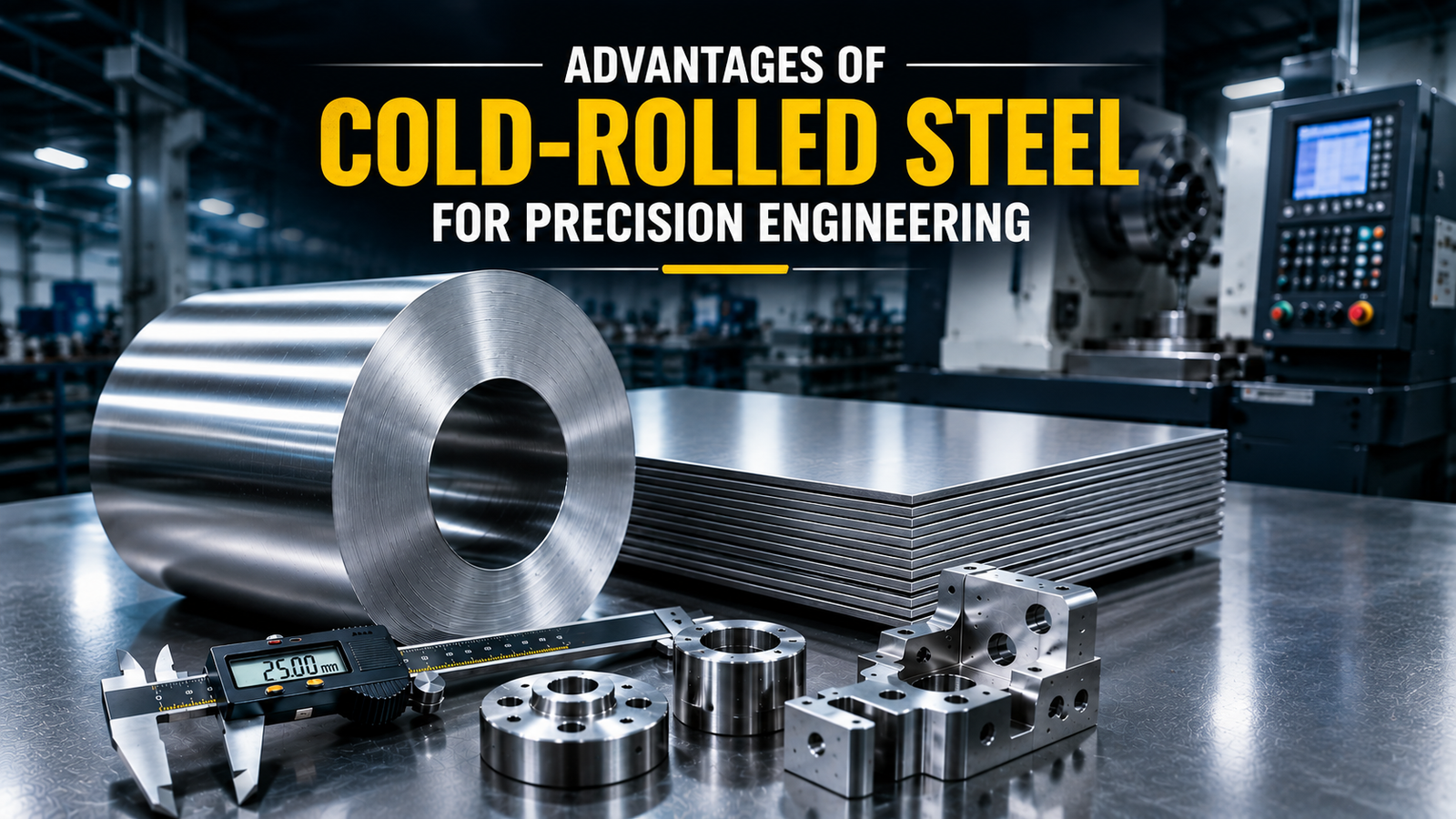
 Cold Rolled Steel
Advantages of Cold Rolled Steel for Precision Engineering
Precision engineering demands materials that can meet strict dimensional, surface, and fabrication requirements. Components used in electrical equipment, automotive parts, appliances, machinery, furniture, and industrial assemblies often need consistent thickness, accurate dimensions, and a clean surface.
This is where Cold Rolled Steel becomes an important material choice. Produced by further processing hot rolled steel at or near room temperature, cold rolling can improve dimensional control and surface quality. The resulting material is widely used for applications where appearance, consistency, forming, and fabrication accuracy matter.
Understanding the Advantages of Cold Rolled Steel for Precision Engineering helps manufacturers, fabricators, engineers, and procurement teams determine whether CR steel is suitable for their production requirements.
What Makes Cold Rolled Steel Suitable for Precision Work?
Cold rolling involves reducing the thickness of steel through controlled rolling after the hot rolling stage. The process can produce tighter dimensional tolerances and a more uniform surface compared with conventional hot rolled products.
For precision-oriented manufacturing, these characteristics can simplify downstream operations and improve consistency between components.
Cold Rolled Steel is commonly available in sheets and coils and can be processed according to specific manufacturing requirements.
1. Better Dimensional Control
One of the major advantages of Cold Rolled Steel is its dimensional consistency. Precision components often require accurate thickness and controlled dimensions because variations can affect assembly, bending, punching, or forming operations.
CR steel can offer tighter dimensional control, making it useful for:
- Electrical Enclosures
- Automotive Components
- Metal Furniture
- Appliance Parts
- Machine Components
- Fabricated Panels
The required tolerances should always be confirmed against the applicable material specification and project requirements.
2. Smooth and Uniform Surface
Cold Rolled Steel generally has a cleaner and smoother surface than many hot rolled products.
This makes it useful when the finished component will be:
- Painted
- Powder Coated
- Plated
- Polished
- Used in a Visible Application
A consistent surface can also reduce preparation work before certain finishing processes, depending on the product and application.
3. Suitable for Forming Operations
Many precision-engineered components require bending, pressing, punching, or forming before reaching their final shape.
Cold Rolled Steel grades designed for forming can be suitable for these processes. However, formability varies by grade, thickness, and processing condition, so the material specification should be selected according to the actual forming requirement.
This makes grade selection just as important as choosing the CR product category.
Key Industrial Applications
The combination of dimensional control and surface quality makes Cold Rolled Steel useful across several industries.
4. Electrical Equipment
CR sheets are commonly used for electrical panels, cabinets, enclosures, control boxes, and other fabricated components.
These products often require accurate dimensions because multiple panels and parts must fit together during assembly.
5. Automotive Components
Automotive manufacturing uses different steel grades for components requiring controlled forming, surface quality, and dimensional consistency.
The appropriate grade depends on the component design, forming requirements, strength level, and applicable automotive specifications.
6. Appliances and Furniture
Refrigerators, washing machines, cabinets, office furniture, storage units, and similar products often require steel with a clean surface and predictable forming characteristics.
Cold Rolled Steel can be used for components that need an attractive finished appearance after painting or coating.
7. General Engineering Components
CR steel is also used for brackets, covers, panels, fabricated parts, machine components, and other engineered products where dimensional consistency is important.
Surface Finish and Finishing Options
Another important advantage is the suitability of many CR products for additional surface treatments.
The final application determines which material options manufacturers may use:
- Painting
- Powder Coating
- Plating
- Decorative Finishing
- Protective Coating
A smooth substrate can support a more uniform finished appearance, although the final result also depends on cleaning, preparation, coating quality, and production conditions.
For visible components, selecting the appropriate surface quality at the purchasing stage can help avoid unnecessary reprocessing.
Strength, Hardness, and Material Selection
Cold rolling can affect the mechanical properties of steel, including strength and hardness. However, it is important not to assume that every Cold Rolled Steel product has the same mechanical performance.
Different grades are designed for different purposes.
Before purchasing, manufacturers should verify:
- Steel Grade
- Yield Strength
- Tensile Strength
- Elongation
- Thickness
- Surface Finish
- Forming Requirements
- Applicable Standard
For precision engineering, the material should be selected according to the component's actual design and service requirements rather than simply choosing CR steel based on its category.
Reduced Fabrication Challenges
Material consistency can have a direct impact on production efficiency.
When sheets or coils have predictable dimensions and surface characteristics, fabricators can plan cutting, forming, and finishing operations more effectively.
This can be particularly valuable for businesses producing large quantities of identical components.
However, production results also depend on tooling, machine settings, operator skill, material grade, and fabrication conditions.
How to Select the Right Cold Rolled Steel
Before placing an order, procurement and engineering teams should clearly define the intended application.
Consider:
- Required Thickness
- Sheet or Coil Dimensions
- Steel Grade
- Forming Requirements
- Surface Finish
- Painting or Coating Requirements
- Quantity
- Applicable Standards
- Documentation Requirements
For projects involving significant forming or demanding tolerances, the material specification should be reviewed with the engineering and production teams before procurement.
Cold Rolled Steel vs Hot Rolled Steel
The two products serve different purposes.
Cold Rolled Steel is generally preferred when dimensional control, surface quality, and precision fabrication are important.
Hot Rolled Steel is commonly selected for structural applications, heavy fabrication, machinery, and projects where a highly refined surface is not the primary requirement.
The appropriate choice depends on the product design, manufacturing process, environmental conditions, and required material properties.
Conclusion
The Advantages of Cold Rolled Steel for Precision Engineering include improved dimensional control, a smoother surface, suitability for forming, and compatibility with various finishing processes. These characteristics make CR steel a practical option for electrical equipment, automotive components, appliances, furniture, machine parts, and precision-fabricated products.
However, selecting the correct grade is essential. Thickness, mechanical properties, forming requirements, surface finish, applicable standards, and final application should all be considered before purchasing.
When the material specification is matched carefully with the manufacturing process, Cold Rolled Steel can support consistent fabrication and reliable finished-product quality.
Contact Us
Looking for Cold Rolled Steel Sheets or Coils for precision engineering and fabrication?
Sandeep Metal Works supplies quality CR steel products for industrial, engineering, manufacturing, furniture, appliance, and fabrication applications.
Contact us today to discuss your required grade, dimensions, quantity, and processing requirements and request a project-specific quotation.
Frequently Asked Questions
1. What are the main advantages of Cold Rolled Steel?
The key benefits include good dimensional control, a smooth surface, consistent thickness, and suitability for various forming and finishing operations.
2. Is Cold Rolled Steel suitable for precision engineering?
Yes. It is commonly used for components where dimensional consistency, surface quality, and controlled fabrication are important.
3. Can Cold Rolled Steel be painted or powder coated?
Yes. Its relatively smooth and uniform surface makes it suitable for many painting and coating applications when properly prepared.
4. Is Cold Rolled Steel stronger than Hot Rolled Steel?
Cold rolling can increase strength and hardness in certain steel products, but the actual properties depend on the grade and processing condition. The applicable material specification should be checked before selection.
5. What should I check before buying Cold Rolled Steel?
Confirm the grade, thickness, dimensions, surface finish, mechanical requirements, applicable standard, quantity, and intended fabrication process before placing the order.