 Stainless Steel
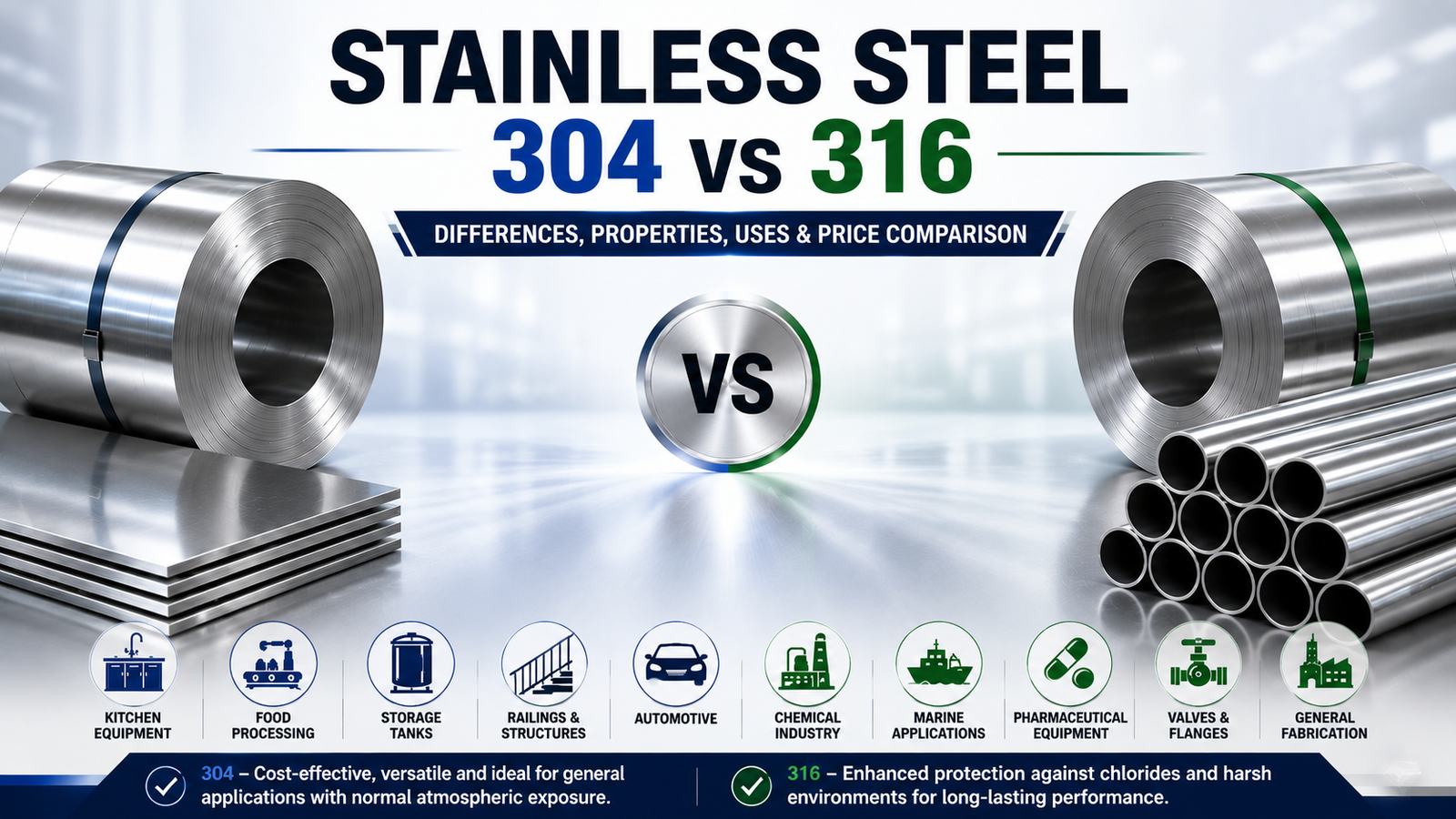
Stainless Steel 304 vs 316: Differences, Properties, Uses & Price Comparison
Stainless steel selection involves more than choosing a material with a polished appearance. The grade can influence how a component handles moisture, chemicals, fabrication operations, cleaning, and long-term service conditions. Among the many available grades, 304 and 316 stainless steel are frequently considered for industrial, commercial, architectural, food-processing, and engineering applications.
At first sight, 304 and 316 can look almost identical, particularly when both are supplied with similar surface finishes. Their internal composition, however, is different. Grade 316 contains molybdenum, which improves its resistance to certain forms of localized corrosion, particularly in chloride-rich environments.
This distinction does not mean that 316 is automatically the better choice. The appropriate grade depends on the environment, fabrication requirements, expected service conditions, maintenance needs, and project budget.
What Makes Stainless Steel 304 a Popular Choice?
304 stainless steel is an austenitic grade valued for its combination of corrosion resistance, formability, weldability, and general-purpose performance. It is commonly associated with chromium and nickel alloying and is available in various product forms, including sheets, coils, and plates.
Because of its balanced properties, 304 is well suited to many everyday applications exposed to ordinary indoor or outdoor conditions.
Common Uses of 304 Stainless Steel
Typical applications include:
- Kitchen and catering equipment
- Food-processing machinery
- Storage tanks
- Industrial components
- Architectural products
- Household appliances
- Railings and fittings
- Automotive components
- General fabrication
For many everyday engineering and commercial requirements, 304 offers a useful combination of performance, availability, and cost.
What Makes 316 Stainless Steel Suitable for Harsh Environments?
316 stainless steel has a similar austenitic structure but includes molybdenum in its alloy composition. This addition improves its resistance to pitting and crevice corrosion in environments where chlorides are present.
Its enhanced corrosion performance makes 316 a strong option for applications exposed to moisture, salts, chemicals, or other aggressive conditions.
Typical Applications of 316
The grade is commonly considered for:
- Chemical-processing equipment
- Pharmaceutical machinery
- Food and beverage equipment
- Medical equipment
- Valves
- Flanges
- Coastal installations
- Chloride-exposed components
- Demanding industrial equipment
The exact grade should still be selected according to the actual operating environment rather than simply choosing 316 because the application is described as “corrosive.”
Stainless Steel 304 vs 316: What Are the Main Differences?
Chemical Composition
The primary distinction between these grades is their alloy chemistry. Both contain chromium and nickel, while 316 additionally incorporates molybdenum. This difference is particularly relevant when evaluating resistance to localized corrosion.
Corrosion Performance
304 performs effectively across many indoor and moderate outdoor applications. However, when chloride exposure becomes significant, 316 generally provides better resistance to pitting and crevice corrosion.
This does not make 316 completely corrosion-proof. Temperature, contaminants, surface condition, fabrication practices, deposits, and maintenance can all influence how stainless steel performs during service.
Coastal and Marine Exposure
Salt-laden air and seawater create more demanding conditions for stainless steel. In such environments, 316 is often considered before 304 because of its improved resistance to chloride-related corrosion.
For exceptionally severe marine conditions, however, engineers may need to evaluate stainless steel grades with even higher alloy content instead of assuming that 316 will meet every requirement.
Fabrication Characteristics
304 and 316 stainless steel are both suitable for common fabrication operations, provided the processing method is selected according to the material grade and project requirements. The specific production method should take into account factors such as material thickness, joint configuration, equipment, and fabrication procedure.
Before ordering, procurement and production teams should confirm that the selected grade is compatible with the planned manufacturing process.
Surface Appearance
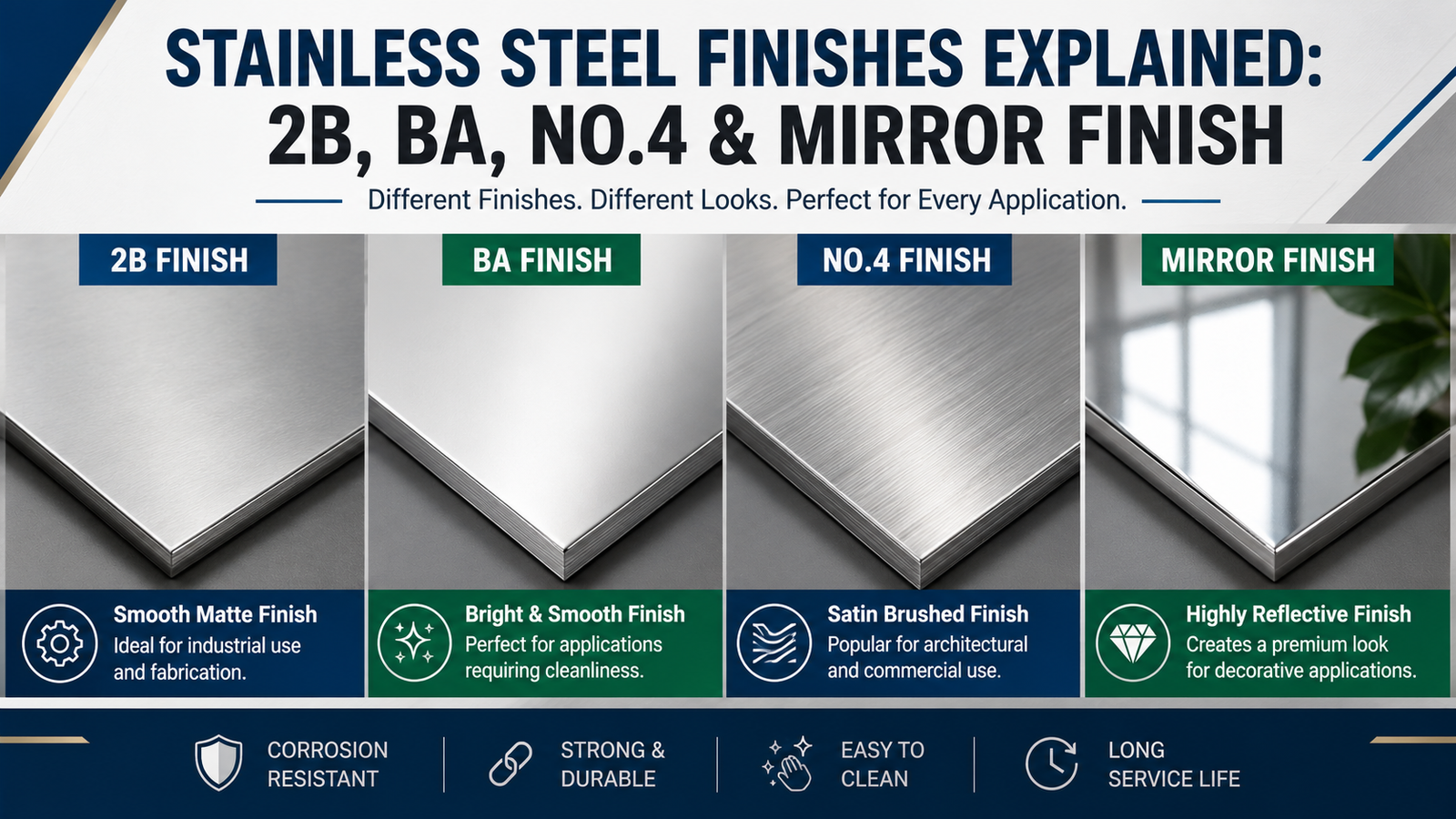
304 and 316 can both be supplied in finishes such as 2B, BA, No.4, and polished surfaces. Consequently, visual appearance should not be used as the primary method for identifying the grade.
For reliable identification, buyers should refer to material markings, certification, traceability records, or appropriate material testing.
Where Are 304 and 316 Stainless Steel Used?
| Application | 304 Stainless Steel | 316 Stainless Steel |
|---|---|---|
| Kitchen Equipment | Commonly Suitable | Commonly Suitable |
| Food Processing | Widely Used | Widely Used |
| Indoor Fabrication | Suitable | Suitable |
| Architectural Work | Suitable | Suitable |
| Pharmaceutical Equipment | Application Dependent | Often Preferred |
| Chemical Equipment | Application Dependent | Often Preferred |
| Coastal Exposure | Depends on Conditions | Generally More Suitable |
| Chloride Exposure | More Limited | Better Resistance |
| Marine Applications | Application Dependent | Generally Preferred |
This comparison is intended as general guidance. When choosing the grade, assess the application environment, technical specifications, applicable standards, and anticipated operating conditions together.
How Does the Price of 304 Compare With 316?
Material price is another important consideration when choosing between these grades. However, there is no permanent fixed price difference because stainless steel pricing changes with market conditions and product specifications.
A quotation may be influenced by:
- Stainless steel grade
- Thickness
- Sheet or coil dimensions
- Surface finish
- Order quantity
- Processing requirements
- Availability
- Manufacturer or mill source
- Nickel and molybdenum prices
- Current market conditions
316 generally carries a higher material cost than 304 because of its alloy composition and molybdenum content. However, the actual difference can change over time.
For procurement decisions, comparing only the price per kilogram can be misleading. Buyers should compare the complete specification, including grade, size, finish, certification, processing, quantity, and delivery requirements.
When Is 304 Stainless Steel the Better Option?
For applications requiring dependable general corrosion resistance without significant contact with chlorides, 304 may offer a suitable balance of performance and cost.
It may suit:
- Indoor equipment
- Kitchen products
- Food-processing equipment
- General engineering
- Architectural components
- Storage equipment
- Household products
- Mild outdoor applications
Its broad application range and fabrication characteristics have made it a widely used stainless steel grade.
The decision should nevertheless be based on actual service conditions rather than simply selecting 304 because it is widely available.
When Should You Consider 316 Stainless Steel?
316 becomes more relevant when the material will operate in conditions where localized corrosion is a greater concern.
Potential applications include:
- Coastal structures
- Marine-related equipment
- Chemical-processing systems
- Pharmaceutical facilities
- Food and beverage equipment
- Chloride-exposed components
- Industrial equipment in aggressive environments
However, “more corrosion-resistant” does not mean universally suitable. The chemicals involved, concentration, temperature, exposure duration, cleaning procedures, and design conditions should all be reviewed before finalizing the grade.
What Should You Check Before Buying 304 or 316?
A good procurement decision begins with a clear material specification.
1. Review the Environment
Identify whether the component will face:
- Moisture
- Salt
- Chlorides
- Chemicals
- Cleaning agents
- High humidity
- Outdoor exposure
These conditions can significantly influence grade selection.
2. Confirm Fabrication Requirements
Consider the complete manufacturing route, including cutting, bending, forming, welding, machining, and surface treatment.
3. Specify the Finish
The required surface should be mentioned clearly in the purchase enquiry. Depending on the project, this could include 2B, BA, No.4, Mirror, or another specified finish.
4. Provide Accurate Dimensions
State the required thickness, width, length, coil details, or cut-to-size requirements before requesting a quotation.
5. Ask for Documentation
Where traceability is important, request suitable material certification and documentation along with the supply.
Providing complete specifications reduces confusion and helps suppliers quote the correct material.
Why Does Supplier Selection Matter?
Choosing the correct grade is only one part of stainless steel procurement. Buyers should also examine sourcing, documentation, processing facilities, stock availability, packing, warehousing, and delivery capabilities.
For projects requiring specific dimensions or processing, working with a supplier capable of providing the required format can simplify procurement and fabrication planning.
Sandeep Metal Works offers stainless steel sheets, coils, and plates in 304 and 316, along with different finishes and processing options.
Conclusion
The choice between Stainless Steel 304 vs 316 should be based on the conditions the material will actually face.
304 is a versatile option for many general industrial, commercial, architectural, food-related, and indoor applications. 316 becomes more suitable when chloride exposure or more demanding environmental conditions increase the risk of localized corrosion.
Cost is another consideration, but the lowest purchase price is not necessarily the best long-term choice. Selecting the appropriate grade can help avoid unnecessary maintenance, replacement, and performance issues.
Before placing an order, compare the grade, environment, dimensions, finish, fabrication requirements, documentation, availability, and overall project cost.
Sandeep Metal Works supplies stainless steel sheets, coils, and plates for industrial, commercial, architectural, and fabrication requirements.
Contact the team with your required grade, thickness, finish, quantity, and processing specifications to discuss your project requirement.
Frequently Asked Questions
1. What is the main difference between 304 and 316 stainless steel?
The key distinction is the alloy composition. 316 contains molybdenum, which provides improved resistance to certain localized corrosion mechanisms, particularly in chloride-containing environments.
2. Is 316 always better than 304?
No. The appropriate grade depends on the operating environment, technical requirements, fabrication process, and budget. 304 can be entirely suitable for many applications where severe chloride exposure is not present.
3. Which grade is more suitable for coastal applications?
316 is generally considered when salt and chloride exposure are significant. For extremely aggressive marine conditions, a higher-alloy stainless steel may need to be evaluated.
4. Can 304 and 316 stainless steel have the same finish?
Yes. Both grades can be supplied with similar finishes, including 2B, BA, No.4, and polished surfaces. Therefore, the finish alone does not confirm the material grade.
5. Why does 316 generally cost more than 304?
The additional alloying elements, particularly molybdenum, contribute to the higher cost of 316. Actual prices also vary with thickness, dimensions, finish, quantity, availability, and market conditions.