 Stainless Steel
Steel Sheets vs Steel Plates: What's the Difference?
A fabrication drawing may specify a flat steel product, but choosing between a sheet and a plate requires more than looking at dimensions. The material must suit the load, forming process, welding requirements, surface expectations, and final application.
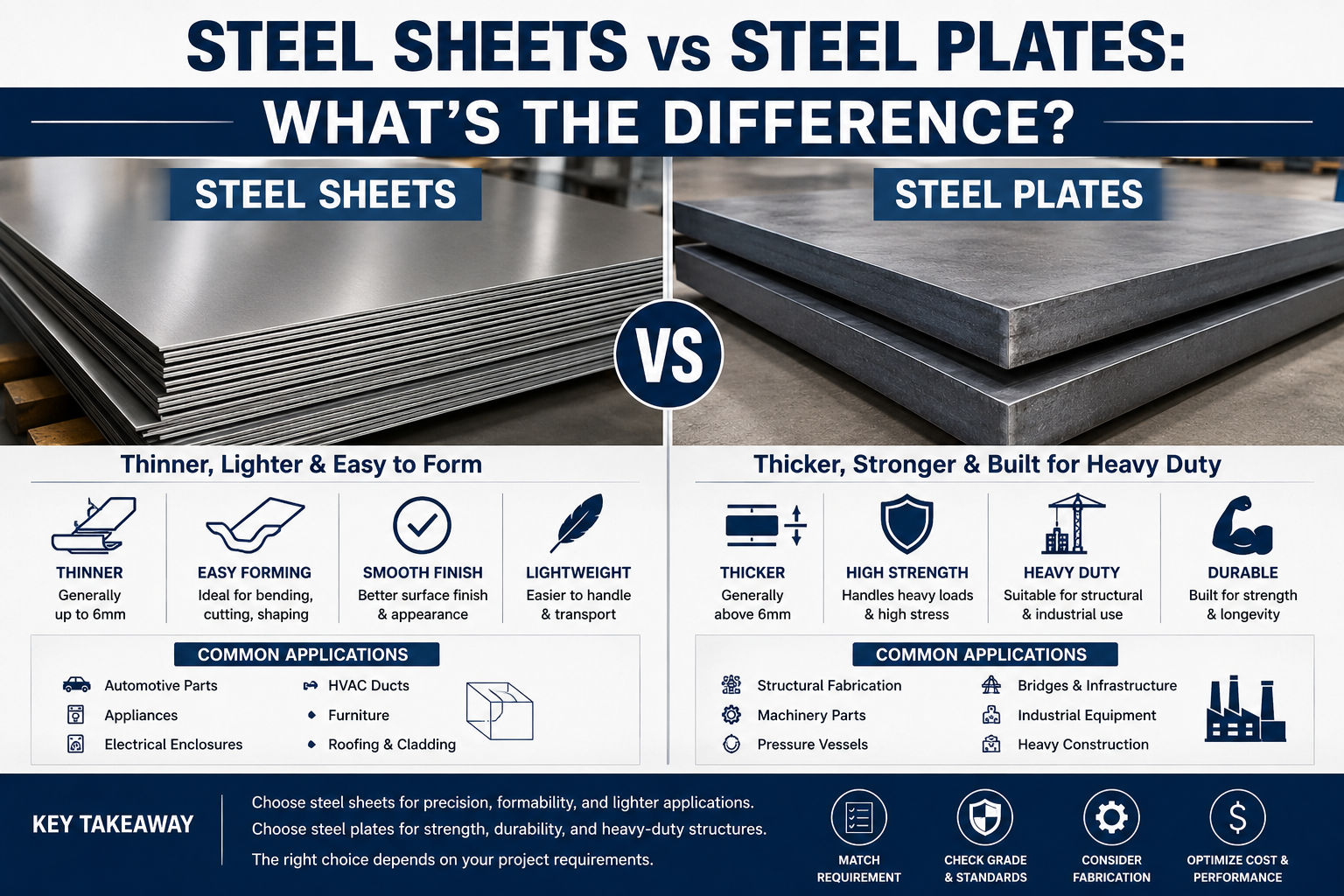
Steel sheets are generally associated with thinner sections and applications that require forming, bending, or a controlled surface finish. Steel plates are typically selected for heavier sections where structural capacity, durability, and resistance to demanding loads are more important. However, exact thickness classifications can vary by standard, grade, mill practice, and market convention.
Understanding Steel Sheets vs Steel Plates: What's the Difference? helps procurement teams, contractors, engineers, and fabricators make better material decisions. Choosing correctly can simplify production, reduce avoidable processing, improve material utilization, and support the intended performance of the finished component.
This guide compares steel sheets and plates based on thickness, manufacturing, strength, surface characteristics, processing, applications, handling, and purchasing considerations.
Understanding Steel Sheets And Steel Plates
Although sheets and plates are both flat steel products, they are selected for different manufacturing and engineering needs.
1. Thickness And Dimensional Classification
Thickness is the most obvious difference between a steel sheet and a steel plate. Sheets are generally thinner, while plates are heavier and thicker. There is no single universal thickness boundary that applies to every steel grade, standard, and supplier classification.
For this reason, buyers should avoid making purchasing decisions based only on product names. The purchase order should clearly mention the required thickness, width, length, grade, standard, quantity, and surface condition.
Steel sheets are often supplied as individual sheets or processed from coils. Plates are usually supplied as flat, cut sections in specified dimensions.
When comparing Steel Sheets vs Steel Plates: What's the Difference?, thickness is a useful starting point, but the actual project specification should always determine the final selection.
2. Manufacturing And Supply Form
Steel sheets may originate from Hot Rolled, Cold Rolled, Galvanized, Stainless Steel, or Color Coated Steel product categories. Depending on the material and production requirement, they can be supplied in standard sizes or processed from coils.
Steel plates are commonly produced for structural fabrication, machinery, equipment manufacturing, and other heavy-duty uses. Because plates are produced in heavier sections, they are often selected for projects that demand robust material dimensions and greater structural capacity.
Supply form also affects production efficiency. A manufacturer processing large quantities of identical components may prefer coils or sheets suited to automated lines. A heavy fabrication company may need plates in project-specific dimensions to reduce unnecessary cutting and scrap.
The correct format depends on the equipment, production volume, component design, and handling capability of the buyer.
Comparing Strength, Surface Finish And Processing
The difference between sheets and plates is not simply that one is thin and the other is thick. Their practical behaviour during fabrication can also differ considerably.
3. Strength And Load-Bearing Requirements
A steel plate is often chosen for applications involving substantial loads, impact, heavy machinery, or structural fabrication. Its greater section thickness can provide the material capacity required by the design.
Steel sheets are widely used where lower weight, forming ability, enclosure design, surface appearance, or component production is more important.
However, thickness alone does not define strength. Steel grade, chemical composition, yield strength, tensile properties, geometry, and design all influence how a component performs.
For safety-critical or load-bearing applications, buyers should follow approved drawings, material specifications, applicable standards, and qualified engineering guidance.
4. Surface Finish And Dimensional Accuracy
Surface requirements can influence the choice of steel as much as mechanical performance.
Cold Rolled Steel Sheets are commonly used where a smoother surface and controlled dimensions are required. These characteristics can be useful for precision components, enclosures, furniture, equipment panels, and other fabricated products.
Hot Rolled Steel may have a different surface condition and is widely used in construction, machinery, structural work, and general fabrication where the application does not require the same finish associated with CR products.
For buyers comparing Steel Sheets vs Steel Plates: What's the Difference?, the decision should be based on how well the material meets the project's technical and fabrication requirements rather than its visual appearance. Consider whether the surface condition and dimensional tolerance are suitable for the next manufacturing stage and final use.
5. Cutting, Bending And Forming
Due to their thinner profile, steel sheets can be shaped and processed efficiently through operations such as bending, stamping, punching, and press forming. Their lower thickness makes them suitable for many fabricated components and high-volume manufacturing processes.
Steel plates require equipment capable of handling heavier sections. Cutting and forming methods depend on plate thickness, grade, required edge quality, dimensional tolerance, and production volume.
Before ordering material, buyers should review:
- Cutting method
- Bending requirements
- Hole and slot requirements
- Edge preparation
- Welding procedure
- Machining needs
- Final component dimensions
Matching the material format to the fabrication process can reduce extra handling and unnecessary processing.
6. Welding And Fabrication Considerations
Both steel sheets and plates can be used in welded assemblies, but the welding approach varies with material grade and thickness.
Thin sheets require careful control to limit distortion or burn-through. Welding heavy plate sections can involve edge preparation, controlled heat input, planned welding sequences, and several weld layers to achieve the required joint quality.
The material grade should always be confirmed before welding. Two products with a similar appearance may have different compositions and fabrication characteristics.
A good procurement process connects material selection with the actual workshop process rather than treating purchasing and fabrication as separate decisions.
Applications Of Steel Sheets And Steel Plates
The easiest way to understand the difference is to examine where each product is commonly used.
7. Common Applications Of Steel Sheets
Steel sheets are used across a wide range of industries because they can be cut, formed, shaped, and processed into different components.
Typical applications include:
- Automotive body and component manufacturing
- Electrical panels and enclosures
- HVAC ducts
- Roofing and cladding
- Appliances
- Furniture
- Equipment covers
- Light fabrication
- Industrial cabinets
- General engineering components
The exact steel category should match the application. Cold Rolled Steel may be selected for precision and surface-sensitive components. Galvanized Steel may be considered where additional corrosion protection is required. Stainless Steel may be appropriate for environments where corrosion resistance, hygiene, or appearance is important.
8. Common Applications Of Steel Plates
Steel plates are widely used in projects that require thicker sections and substantial structural or mechanical performance.
Applications may include:
- Structural fabrication
- Heavy machinery
- Industrial equipment
- Equipment bases
- Bridges and infrastructure components
- Heavy engineering projects
- Fabricated frames
- Industrial platforms
- Large support structures
- General heavy fabrication
Material grade and thickness should be selected according to design requirements. A plate that is suitable for one fabrication project may not meet the technical requirements of another.
The comparison of Steel Sheets vs Steel Plates: What's the Difference? becomes clearer when the end use is defined first. If the project involves forming lightweight components, a sheet product may be appropriate. If the design requires a heavier section for structural or mechanical duty, a plate may be the better option.
Selecting The Right Option: Steel Sheets Or Steel Plates
The correct purchasing decision starts with the application, not with the product name.
9. Project And Fabrication Requirements
Before asking for pricing, procurement teams should clearly define the required steel type, grade, dimensions, quantity, processing needs, and technical specifications. This improves communication and reduces the chance of incorrect supply.
Check the following factors:
- Application: Define exactly where and how the steel will be used.
- Grade: Confirm the specified steel grade and applicable standard.
- Thickness: Use the project drawing or technical requirement rather than assumptions.
- Dimensions: Specify the required width and length.
- Surface Condition: Consider whether the finished component needs a specific visual quality or will undergo painting, coating, polishing, or another finishing process.
- Corrosion Exposure: Consider moisture, weather, chemicals, and other environmental conditions.
- Fabrication Process: Review cutting, bending, forming, machining, and welding requirements.
- Quantity: Confirm whether the project needs sheets, plates, coils, or processed material.
- Documentation: Identify any certification or traceability requirements before ordering.
These factors provide a practical answer to Steel Sheets vs Steel Plates: What's the Difference? because the right choice depends on the complete technical and production requirement.
10. Cost, Handling And Material Utilization
Price per tonne should not be the only factor considered when comparing steel products.
A material that requires extensive cutting, creates excessive scrap, or causes production delays may increase the overall project cost even if its initial purchase rate is attractive.
Consider the complete procurement impact:
- Material price
- Processing cost
- Scrap generation
- Handling requirements
- Storage space
- Equipment capability
- Packaging
- Transportation
- Delivery schedule
- Production efficiency
Sheets can be easier to handle in many fabrication environments, while plates require suitable lifting, storage, and processing arrangements. Buyers should evaluate whether their workshop has the equipment needed to safely and efficiently process the selected material.
For large orders, discussing processing and supply formats before purchase can improve material utilization and production planning.
Making The Right Steel Selection For Your Project
The practical answer to Steel Sheets vs Steel Plates: What's the Difference? comes down to application, thickness, grade, processing, and expected performance.
Steel sheets are generally selected for thinner components, forming operations, enclosures, automotive parts, roofing, appliances, and precision fabrication. Steel plates are more commonly associated with heavier fabrication, machinery, structural work, equipment bases, and infrastructure applications.
Neither option is universally better. A well-selected steel sheet can be the correct material for a precision component, while a properly specified plate may be essential for a heavy industrial structure.
Buyers should begin with approved technical requirements, confirm the grade and dimensions, review fabrication needs, and then select the most efficient supply format. This approach helps avoid specification errors and supports smoother procurement and production.
For industrial buyers, reliable steel sourcing also involves more than material availability. Processing capability, documentation, warehousing, packaging, communication, and delivery planning can influence overall project efficiency.
Conclusion
Understanding Steel Sheets vs Steel Plates: What's the Difference? allows buyers to select materials based on real project needs rather than general assumptions.
Steel sheets are practical for many precision, forming, enclosure, roofing, and component manufacturing applications. Steel plates are suited to numerous heavy fabrication, structural, machinery, and infrastructure requirements. The right choice depends on grade, thickness, loading conditions, fabrication method, environmental exposure, and final use.
Detailed purchasing specifications give the supplier a precise understanding of the requirement while helping the workshop prepare its cutting, forming, and fabrication workflow in advance. Before placing a bulk order, confirm the technical requirement, supply format, processing needs, documentation, and delivery schedule.
Looking For The Right Steel Material For Your Project?
Whether your requirement involves steel sheets, coils, plates, or flats, choosing the correct material can improve fabrication efficiency and project planning.
Sandeep Metal Works supplies steel products for construction, engineering, fabrication, manufacturing, and industrial applications, supported by processing and supply capabilities.
Contact Us Today to discuss your steel specifications and request a customized quotation for your project.
Frequently Asked Questions
1. What is the main difference between steel sheets and steel plates?
The primary difference is generally thickness and intended application. Steel sheets are typically used for forming and lighter fabrication, while plates are commonly selected for heavier structural and industrial applications.
2. Are steel plates stronger than steel sheets?
Plates are thicker and are often used for heavy-duty applications, but actual performance depends on the steel grade, dimensions, design, and mechanical properties required by the project.
3. Which is better for fabrication: steel sheet or steel plate?
The answer depends on the component. Sheets are suitable for many bending, forming, and light fabrication jobs, while plates are commonly used for heavy fabrication and structural work.
4. Can steel sheets and plates be supplied in custom sizes?
Depending on material availability and processing capabilities, steel can be supplied or processed into project-specific dimensions through services such as cut-to-length and other suitable processing methods.
5. What details should I provide when ordering steel sheets or plates?
Provide the steel type, grade, thickness, width, length, quantity, surface requirements, applicable standard, processing needs, and any required material documentation.